
Summary
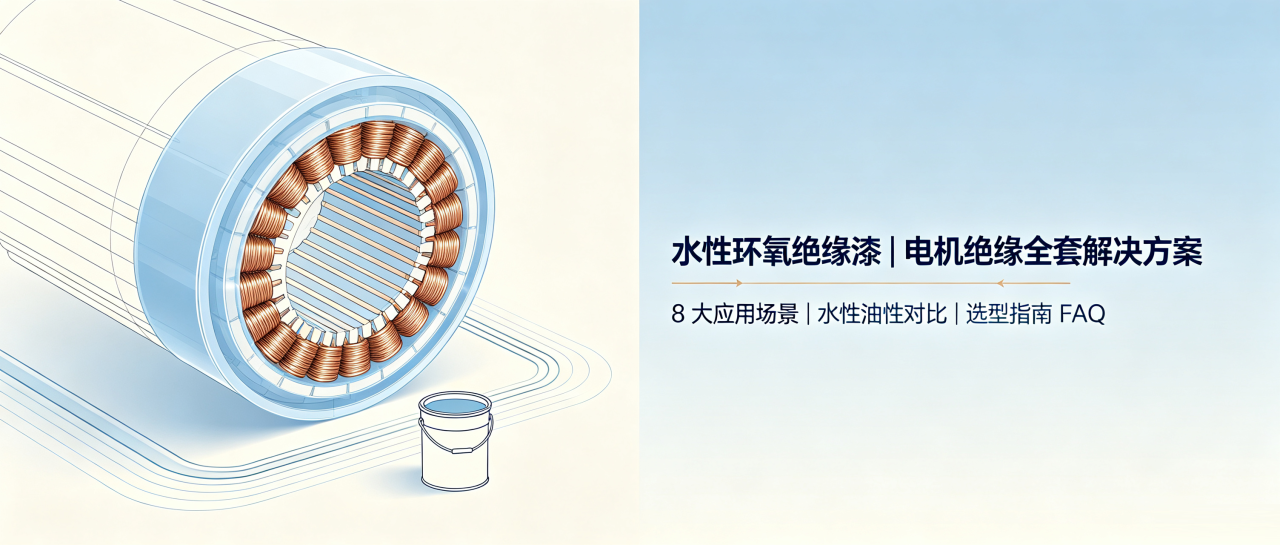
Water-based epoxy insulation paint is a high-performance coating for motor windings that uses water as the dispersion medium. It features zero VOC emissions, H-class heat resistance (180°C), high dielectric strength, and strong adhesion. Widely used in home appliance motors (washing machines, air conditioners, range hoods), power motors (electric vehicles, generators), and industrial equipment (compressors, high-frequency transformers). This article covers 8 typical application scenarios, compares 3 core differences between water-based and oil-based paints, outlines key selection parameters, and answers 6 common questions.
1. What is water-based epoxy insulating varnish?
Waterborne epoxy insulating varnish is an epoxy-based insulation coating that uses water as a carrier instead of organic solvents. Applied via impregnation or coating, it penetrates the gaps between enameled wires in motor stator/rotor windings and cures to form a dense, continuous protective insulation layer.
Four Core Features
Electrical insulation: prevents inter-turn short circuits and ground faults in windings.
Mechanical Fixation: Bonds loose coils into a solid unit to reduce electromagnetic noise and vibration.
Environmental Protection: Seals out moisture, oil, corrosive gases, and dust
Auxiliary cooling: Fill the air gaps between coils to leverage the higher thermal conductivity of the enamel coating compared to stagnant air, enhancing heat dissipation.
Typical Technical Indicators
Insulation Class: H (180°C)
Dielectric Strength (Normal): ≥70 kV/mm
Volume resistivity (normal state): ≥1×10^14 Ω·m
Volume resistivity (after 24h immersion): ≥1×10^12 Ω·m
Adhesion (Cross-cut test): ≤1 grade
VOC Content: Near Zero
Curing conditions: Bake at 130°C–150°C for 1–2 hours.
Storage conditions: 5℃–35℃, keep sealed. Shelf life: 6 months (below 25℃)
Note: Specific parameters vary by product model; the values above are typical references.
II. 8 Major Motor Insulation Application Scenarios and Waterborne Epoxy Paint Solutions
Washing Machine Motor Insulation – Moisture and Condensation Protection
Operational Pain Point: During washing, water vapor seeps through the shaft gap. During spin cycles, high-speed motor rotation generates heat. The resulting thermal cycling causes condensation on the windings, leading to moisture ingress, inter-turn short circuits, and potential motor burnout.
Water-based Epoxy Coating Solution: Utilizing vacuum impregnation, the water-based epoxy resin fills every microscopic gap between enameled wires without solvent-evaporation pinholes. Upon curing, it forms a fully sealed, dense protective layer that completely blocks moisture pathways.
Maintains stable insulation resistance in humid environments to eliminate leakage risks and extend motor life.
Range hood motor insulation – heat and oil resistant
Operational Pain Point: The kitchen environment is consistently hot (> 60°C), greasy, and filled with corrosive fumes. Standard insulating varnish swells and degrades under these conditions, causing the insulation to soften and the motor to seize.
Water-based Epoxy Coating Solution: Features a highly cross-linked film with superior chemical stability, excellent oil and solvent resistance. Oil and grime resist adhesion and wipe off easily. Performs reliably under prolonged high-temperature conditions.
Ideal for high-grease environments like restaurant kitchens, reducing the frequency of motor replacements.
HVAC/Fan Motor Insulation – Noise Reduction & Vibration Damping
Pain Point: High noise from outdoor AC units and a "buzzing" sound during fan operation are largely caused by electromagnetic forces and mechanical vibrations due to loose windings.
Water-based epoxy coating solution: Bonds loose coils into a solid unit after dipping (known as "core curing"), eliminating relative coil movement to significantly reduce electromagnetic noise and mechanical vibration.
Quieter operation, softer airflow, and a more comfortable night mode.
Electric Vehicle Motor Insulation – Heat Resistance and Dielectric Strength
Operational Pain Point: During high-current discharge (e.g., climbing or heavy loads), rapid temperature spikes occur. If the insulation material's thermal rating is insufficient, thermal breakdown can happen, leading to increased magnetic losses and reduced power output.
Water-based Epoxy Coating Solution: Features an H-class (180°C) heat-resistant formulation that withstands high-temperature shock without softening or deforming, maintaining stable insulation resistance throughout the rated temperature range.
Performance: Electric two-wheeler and tricycle motors maintain stable insulation performance under sustained heavy loads, ensuring consistent and reliable power output.
Gasoline generator motor insulation: vibration-resistant and wear-resistant
Pain Point: Portable generators experience severe vibration during operation. Under the combined effects of electromagnetic forces and mechanical vibration, the windings are prone to insulation wear or displacement.
Water-based Epoxy Coating Solution: Offers exceptional adhesion (≤1 grade by cross-cut test), securely locking the coil within the stator slot to prevent displacement or wear caused by vibration.
Ideal for outdoor mobile operations and emergency power in rugged, high-vibration environments. Delivers stable, reliable power output.
Compressor Motor Insulation: High Dielectric Strength to Prevent Breakdown
Application Pain Points: Refrigerator compressors and industrial air compressors operate under high pressure and high speed, resulting in high inter-turn voltage. This demands stringent dielectric strength from the insulation layer. Inadequate insulation can lead to inter-turn short circuits or even explosions.
Waterborne Epoxy Coating Solution: Delivers superior dielectric strength (≥70 kV/mm under normal conditions), withstands high voltage without breakdown, and serves as a critical safety barrier for industrial operations.
Reduces the risk of compressor motor failure to ensure safe, continuous production.
High-Frequency Transformer Insulation – Low Loss, Heat-Resistant
Application Pain Points: High-frequency transformers in switch-mode power supplies and EV chargers operate at high frequencies, causing significant eddy current losses and severe heating. Conventional insulation varnishes soften and melt under sustained high temperatures, leading to coil short circuits.
Water-based epoxy coating solution: Maintains excellent electrical performance and mechanical strength under high-frequency conditions, features a high heat deflection temperature to ensure current transmission accuracy and minimize signal interference.
Ideal for insulation requirements in high-frequency power electronics, including charging piles, UPS systems, and PV inverters.
Series Motor Insulation: Suppressing Spark Tracking
Industry Pain Point: Series-wound motors in power tools like drills and angle grinders generate continuous sparks between the brushes and commutator, leading to surface tracking on windings. This causes insulation carbonization and poses a fire hazard.
Water-based epoxy coating solution: The insulating varnish effectively suppresses surface tracking caused by electric sparks, prevents the extension of carbonization channels in windings, and significantly reduces fire risk.
Enhances power tool safety and extends brush and commutator life.
III. Water-Based vs. Oil-Based Insulating Varnish: 3 Key Comparisons
The following comparison highlights typical differences between waterborne and solvent-based products within the same grade of epoxy resin systems:
Environmental Compliance: VOC Emissions
Water-based paint: Uses water as the dispersing medium, with VOCs approaching zero. Complies with EU RoHS and REACH regulations for export and requires no investment in waste gas treatment equipment.
Oil-based paint: Contains high levels of organic solvents (e.g., toluene, xylene), resulting in significant VOC emissions. Requires dedicated exhaust collection and treatment systems, leading to higher environmental compliance costs.
Conclusion: For production lines with mandatory environmental compliance requirements (e.g., appliances exported to the EU), water-based is the preferred choice.
Insulation Reliability: Pinholes and Filling Effectiveness
Water-based paint: No solvent emissions, pore-free film. After impregnation, it fills all microscopic gaps between enameled wires, creating a dense, continuous insulation layer with superior dielectric strength.
Oil-based paints: Solvent evaporation can create pinholes, leaving micro-channels in the film that pose a breakdown risk under high voltage.
Conclusion: For precision motors and high-voltage motors with high insulation reliability requirements, water-based coatings are the preferred choice (offering the advantage of no pinholes).
Job Safety and Storage & Transportation
Water-based paint: Non-flammable liquid with no hazardous material restrictions during transport. Store at 5°C to 35°C. Odorless application environment improves worker conditions.
Oil-based paint: Flammable liquid requiring hazardous materials transport certification, storage in explosion-proof warehouses, and solvent emissions in work areas pose fire and explosion risks.
Conclusion: The drying section cannot be retrofitted on the current line in the short term. Continue using solvent-based coatings as a temporary measure while planning the transition to water-based coatings.
IV. Frequently Asked Questions (FAQ) about Waterborne Epoxy Insulating Varnish
Q1: Can water-based epoxy insulation paint fully replace oil-based paint?
Yes, for the vast majority of motor impregnation applications. Waterborne epoxy coatings outperform solvent-based ones in insulation filling, VOC emissions, and operational safety, while achieving equivalent thermal ratings (Class H). Only on legacy production lines with strict curing constraints might line upgrades be required to enable their use.
Q2: What is the maximum temperature rating for Class H insulation varnish, and how does it differ from Class F?
A: H-class insulation materials support a maximum continuous operating temperature of 180°C, while F-class supports 155°C. The H-class rating is 25°C higher than F-class and is suited for motors with high operating temperatures or stricter safety margins (e.g., EV motors, compressor motors). Note that the H-class rating refers to the "continuous thermal stability temperature," not the short-term peak temperature tolerance.
Q3: What is the insulation resistance achieved with water-based insulating varnish?
A: Taking Guangzhou Feisi waterborne epoxy paint as an example, the volume resistivity is ≥1×10^14 Ω·m under normal conditions and remains above 1×10^12 Ω·m after 24 hours of immersion (typical value). Specific values depend on the impregnation process, film thickness, and testing environment.
Q4: Will water-based epoxy insulating varnish affect motor heat dissipation?
No, it actually helps. Still air has a thermal conductivity of only about 0.026 W/(m·K), while the epoxy coating ranges from 0.2 to 0.3 W/(m·K)—roughly 10 times higher than air. When the liquid epoxy fills the gaps between windings, it creates a more efficient heat conduction path, improving motor heat dissipation.
Q5: Do water-based coatings require stringent curing conditions? Will existing production lines need retrofitting?
Typical curing conditions are baking at 130°C–150°C for 1–2 hours. If your existing production line already has an oil-based paint baking zone, the temperature range is usually compatible. Key modifications include: ① Enhance dehumidification and ventilation in the baking zone (water-based paints release moisture during initial curing); ② Add a preheating zone (60–80°C) to improve impregnation efficiency. Final parameters should be confirmed through process trials.
Q6: Are there special requirements for storing and transporting water-based paint?
Recommended storage temperature: 5°C–35°C. Do not freeze; freezing is irreversible for water-based systems. Store in a sealed container. Shelf life is typically 6 months when stored below 25°C. No hazardous materials regulations apply during transport, making it more convenient than oil-based paints (classified as flammable liquids).
5. Brand Introduction
The electric motor is society's most undervalued "invisible worker"—from the first spin of your washing machine at dawn to the last breath of cool air from your AC at night, from the power behind every climb in an electric vehicle to the hum of every factory assembly line.
And the insulating varnish is the invisible lifeline within these motor housings.
Promoting water-based epoxy insulating varnish is not only a response to environmental regulations but also a systemic upgrade for motor reliability. Guangzhou Feisi Synthetic Materials Co., Ltd. specializes in the R&D and mass production of high-performance water-based insulation materials, offering tailored solutions ranging from home appliances to industrial applications, from micro motors to large generators.