
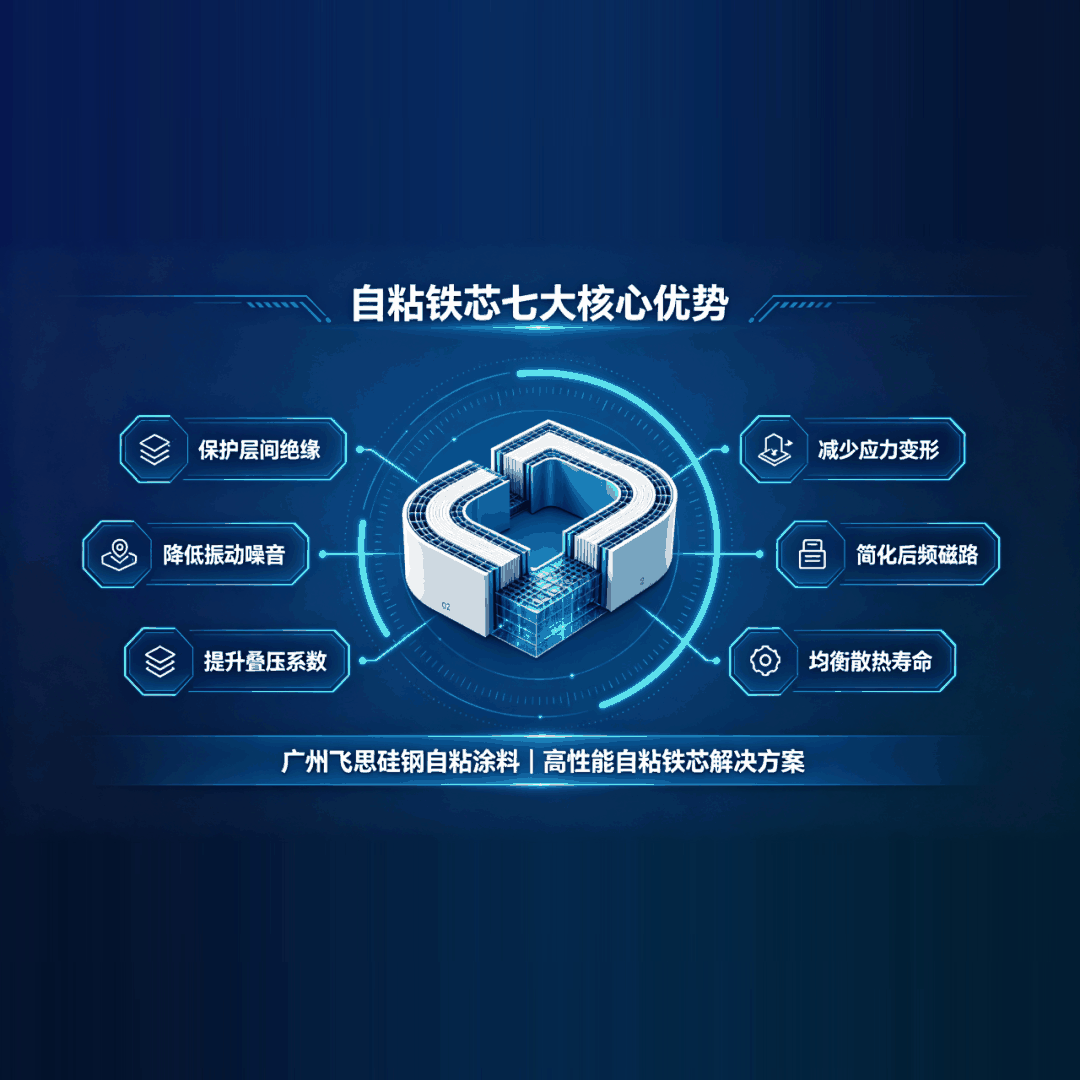
The motor core is the magnetic heart of the motor. Traditional core formation relies on riveting or welding. As demand for energy efficiency, NVH performance, and power density grows in new energy motors, high-speed servos, and industrial robots, self-bonded cores made with Guangzhou Feisi's self-adhesive silicon steel coating are becoming the preferred solution for premium applications.
What advantages do self-adhesive cores offer over riveted or welded assemblies? This article explains them step by step, starting with the underlying process principles.
1. What is a self-adhesive core?
Self-adhesive iron cores represent a next-generation lamination process, relying on silicon steel self-adhesive coatings for成型. A specialized adhesive coating is pre-applied to the surface of silicon steel sheets. After stacking, low-temperature heating and pressure trigger cross-linking and curing of the coating, uniformly bonding all stamped laminates into a single unit across their entire surfaces—eliminating the need for rivet piercing or spot welding, thereby addressing structural defects inherent in traditional manufacturing methods at the source.
In comparison:
铆接工艺:依靠铆钉机械挤压锁紧叠片
焊接工艺:通过局部高温熔合固定叠片
自粘工艺:全表面均匀粘结,一体化成型
Both riveting and welding directly damage the original insulation coating on silicon steel sheets, generating mechanical or thermal stress—the primary cause of core performance loss.
II. Seven Core Advantages of Self-Adhesive Cores
Advantage 1: Fully preserves interlayer insulation to reduce eddy current losses and strictly control core temperature rise.
The high heat of welding and the mechanical compression/piercing from riveting locally damage the insulation coating on silicon steel sheets, creating numerous interlayer short circuits. The more short-circuit points exist, the higher the eddy current losses, directly causing increased core temperature rise and reduced motor operating efficiency.
The lamination temperature in the self-adhesive process remains below the damage threshold of the silicon steel insulation coating, ensuring no mechanical puncture or structural compromise. This preserves the native insulation integrity of the silicon steel sheets, verified by interlayer insulation resistance testing per GB/T 2522.
实测数据:同等工况下,0.35mm 无取向硅钢同规格铁芯,自粘工艺较点焊工艺铁损降低约 12%,铁芯温升降低 8 K。
The cured self-adhesive coating forms a continuous, dense insulating protective layer with excellent interlayer insulation stability. It effectively reduces eddy current and hysteresis losses, meeting the long-term reliability requirements of high-efficiency energy-saving motors and new energy drive motors.
Advantage 2: Fully integrated molding reduces inter-layer vibration and optimizes motor NVH performance.
传统铆接仅靠铆钉点位固定、焊接依靠局部焊缝锁固,叠片之间存在微小间隙。电机高速运行时,叠片易产生高频微振动,引发电磁共振,放大运行噪音,是电机 NVH 不达标的核心原因之一。
The self-adhesive process uses full-surface bonding to form a monolithic structure. This ensures uniform rigidity across the entire core, eliminates gaps and loosening between laminations, and prevents uneven local stress, effectively suppressing high-frequency vibration of the laminations.
实测数据:相较于铆焊铁芯,自粘铁芯运行噪音可降低 3-8 dB,尤其适配高速伺服电机、车载驱动电机、精密主轴电机等对噪音、振动严苛的应用场景。
优势3:无结构损耗,叠压系数更高,提升电机功率密度
Riveting requires pre-drilled holes, consuming effective lamination space; welding's high heat causes local warping and deformation. Both processes reduce the stacking factor, limiting motor power density improvements.
Rivet-free, weld-free self-adhesive cores maintain structural integrity without deformation. Laminations bond tightly and uniformly; under testing conditions excluding adhesive layers, the stacking factor reaches 98%–99%, significantly outperforming traditional methods. For equivalent core volume, the self-adhesive structure delivers higher magnetic flux, enabling compact, lightweight motor designs.
优势4:应力均匀释放,成型精度高,适配复杂异形结构
Mechanical compressive stresses from riveting and localized thermal stresses from welding cause core warping and deformation, compromising stator-rotor coaxiality. This significantly increases rework costs for subsequent shaping and results in poor forming consistency.
自粘涂层固化反应温和,应力全域均匀释放,无局部应力集中问题,铁芯成型形变极小,尺寸一致性、同轴度精度大幅提升。同时可适配超薄、窄槽、异形、微型等复杂铁芯结构,解决传统铆焊工艺无法加工精密异形铁芯的行业痛点。
Advantage 5: Extremely simple process, no secondary contamination, compatible with automated mass production lines.
焊接工艺会产生焊渣、氧化皮、毛刺,必须增加打磨、除氧化、清洁等后处理工序;铆接工艺包含冲孔、配铆钉、压铆、校验等多道工序,耗材多、人工成本高、量产效率低。
The self-adhesive iron core is molded in a single hot-press curing step, eliminating the need for grinding or secondary cleaning. The surface remains clean and free of impurities, significantly streamlining production processes while reducing labor costs and scrap rates. Fully compatible with automated stacking and curing lines.
Advantage 6: Continuous, undistorted magnetic circuit ensures stable electromagnetic performance under high-frequency conditions.
铆钉孔、焊接焊缝断点会直接打断铁芯磁路连续性,造成局部磁阻异常、磁饱和不均。在高频变频工况下,附加损耗会急剧攀升,导致电机性能衰减。
自粘铁芯整体磁路完整连续,无结构性断点,可规避铆孔、焊点引发的局部磁路畸变与磁饱和问题,在高速变频、高频伺服、车载动态工况下,电磁输出稳定性更强。
优势7:全域均匀散热,消除局部热点,延长电机服役寿命
焊接热影响区、铆接固定点位易形成结构死角与应力集中区,叠片间隙不均导致层间热阻差异大,运行时极易产生局部热点,加速绝缘材料热老化。
Self-adhesive core laminations bond tightly with uniform, low interlayer thermal resistance for rapid heat dissipation across the entire area. This effectively minimizes local hot spots, slows insulation aging, and extends the overall service life of the unit.
III. Comparison Table of Eight-Dimensional Parameters for Three Core Manufacturing Processes
Comparison Criteria | 自粘铁芯 | 铆接铁芯 | 焊接铁芯 |
|---|---|---|---|
铁损表现 | Reduced core loss by 12%, temperature rise reduced by 8K, and extremely low losses. | 中等,点位绝缘破损,涡流损耗偏高 | High, large thermal damage area, significant increase in iron loss. |
NVH Performance | Seamless full-surface fit with vibration damping and noise reduction, delivering superior high-frequency noise performance. | 点位固定有间隙,易片振,噪音表现一般 | Welds are prone to deformation, exhibit noticeable resonance, and have poor high-frequency noise performance. |
compression ratio | 98%~99% (calculated without adhesive layer) | 94%~96%(铆钉孔占用空间) | 95%~97%(焊缝易翘曲形变) |
Dimensional Accuracy | Stress-free deformation with exceptional coaxiality and consistency. | 机械挤压易变形,成型精度一般 | Thermal stress warping with significant dimensional deviation |
Post-processing | No polishing or cleaning required. Minimal process, no secondary processing. | Multi-step process: punching, riveting, and verification required. | Requires slag removal, grinding, and oxide scale removal; high rework rate. |
磁路均匀性 | 无断点无畸变,高频电磁性能稳定 | Rivet holes break the magnetic circuit, causing local magnetic saturation. | 焊缝磁阻异常,高频损耗激增 |
Heat dissipation | Uniform interlayer thermal resistance with no localized hot spots | 间隙热阻不均,易产生局部热点 | Concentrated heat-affected zone with significant temperature variation |
量产成本 | 综合成本低,良品率高,适配自动化量产 | 耗材、人工成本高,量产效率有限 | High scrap rate increases overall costs due to post-processing. |
No one-size-fits-all process exists—only the optimal solution for each application. Self-adhesive core technology, with its performance advantages, is best suited for high-end motor applications such as high-efficiency energy-saving systems, high-speed variable-frequency drives, low-noise precision motors, and new energy vehicle powertrains. For mass-market, cost-sensitive general-purpose motors, traditional riveting and welding processes remain highly cost-effective due to their maturity and low material costs. Companies should select the appropriate process based on product positioning and operating requirements.
IV. Frequently Asked Questions
Q1:自粘铁芯长期运行是否会出现叠片脱层、松片问题?
A:自粘铁芯的粘结可靠性由涂料体系与固化工艺决定。标准环氧类自粘涂层固化后,搭接剪切强度可达 1218 MPa (tested at room temperature). Features a full-surface uniform load-bearing design, unlike riveted or welded structures that concentrate stress at specific points. At -40No delamination, flaking, or cracking observed in samples under thermal cycling at 150℃ and high-frequency vibration simulation. Boundary conditions: When long-term operating temperature exceeds the coating's glass transition temperature (typically 150~180℃ for conventional systems), bond shear strength will degrade. Verify the coating's temperature rating in advance for ultra-high-temperature applications.
Q2:自粘工艺相较于铆焊,量产综合成本是否更高?
During the small-batch pilot phase, self-adhesive processes incur slightly higher per-batch costs due to curing equipment and temperature control requirements; however, they offer superior cost competitiveness in high-volume production. By eliminating multiple steps such as punching, riveting, spot welding, grinding, and deoxidation, this process significantly reduces labor and equipment wear while achieving a much higher yield rate compared to riveted/welded methods, resulting in minimal rework and scrap costs.
Q3: Which silicon steel grades are compatible with the self-adhesive coating? Can it process ultra-thin and custom-shaped cores?
Compatible with mainstream high- and low-grade non-oriented cold-rolled silicon steel; reliably processes ultra-thin laminations of 0.2mm, 0.25mm, and 0.35mm. Ideal for complex core structures with narrow slots, micro-scale features, and irregular shapes that traditional riveting or welding cannot handle. The self-adhesive process offers exceptional adaptability, effectively addressing challenges in precision forming and accuracy for intricate cores.
Q4:自粘铁芯的绝缘、耐温性能能否适配高端车规、工业工况?
A:按 GB/T 2522 标准测试,自粘铁芯层间绝缘电阻稳定,可有效杜绝层间短路问题,涂层具备优异的耐热、耐老化、耐湿热性能,可满足绝大多数工业电机、新能源车载驱动电机的常规工况要求。边界条件:持续超 180℃ 极端高温、高盐雾腐蚀的特殊工况,需定制耐高温、耐腐蚀专用涂层体系。
Q5:自粘工艺对产线要求高吗?能否适配现有自动化设备?
Highly adaptable; requires no major production line overhaul. Standard coating and hot-press curing equipment is sufficient for production, enabling seamless integration with automated stacking, curing, and inspection lines. Processes are standardized with high consistency. Constraints: Curing temperature, pressure, and time parameters must be strictly controlled; deviations directly impact bonding strength and insulation performance.
5. About Guangzhou Feisi Silicon Steel Self-Adhesive Coating
从能效损耗、振动噪音、尺寸精度到量产稳定性,自粘铁芯工艺从根源上解决了传统铆焊工艺的固有缺陷,成为高端电机工艺升级的核心方向。
For precision core forming needs across industries, Guangzhou Feisi offers a mature self-adhesive silicon steel coating system and customized process solutions that balance performance, accuracy, and mass production readiness. We support sample testing, application-specific adaptation, and technical collaboration.
本文由广州飞思技术部工程师审核,测试依据:GB/T 2522 及行业电机铁芯量产通用标准。上述实测数据随硅钢牌号、运行工况浮动,可索取完整实测报告。
Contact:
Guangzhou Faith Synthetic Materials Co., Ltd.
Official hotline: 020-82793066
Water-based Paint Business: Engineer Liu 15920494556
Thiol Business: Engineer Zhang 13609004936
Overseas Hotline (Mobile): +86 15920494556
Silicon Steel Self-Adhesive Coating / Waterborne Epoxy Insulating Varnish. For authentic products, choose the Guangzhou Feisi brand. To obtain full test reports, process selection recommendations, or sample support, please contact our technical team via the methods above.